



Workplace projects rarely encounter a single point of failure. Instead, performance is shaped by a series of small decisions made across phases, teams and disciplines. When these decisions don’t align sufficiently, their effects accumulate over time. They often become visible only once cost, programme or operational flexibility have already been compromised.
This article explores how a structured workplace delivery methodology can translate alignment into a practical discipline, supporting continuity from early strategy through to delivery and operation.
Workplace projects today are delivered by experienced consultants, contractors and client teams working in close collaboration. The focus, therefore, is not on capability. It is on how intent is carried through the delivery process and how continuity is maintained.
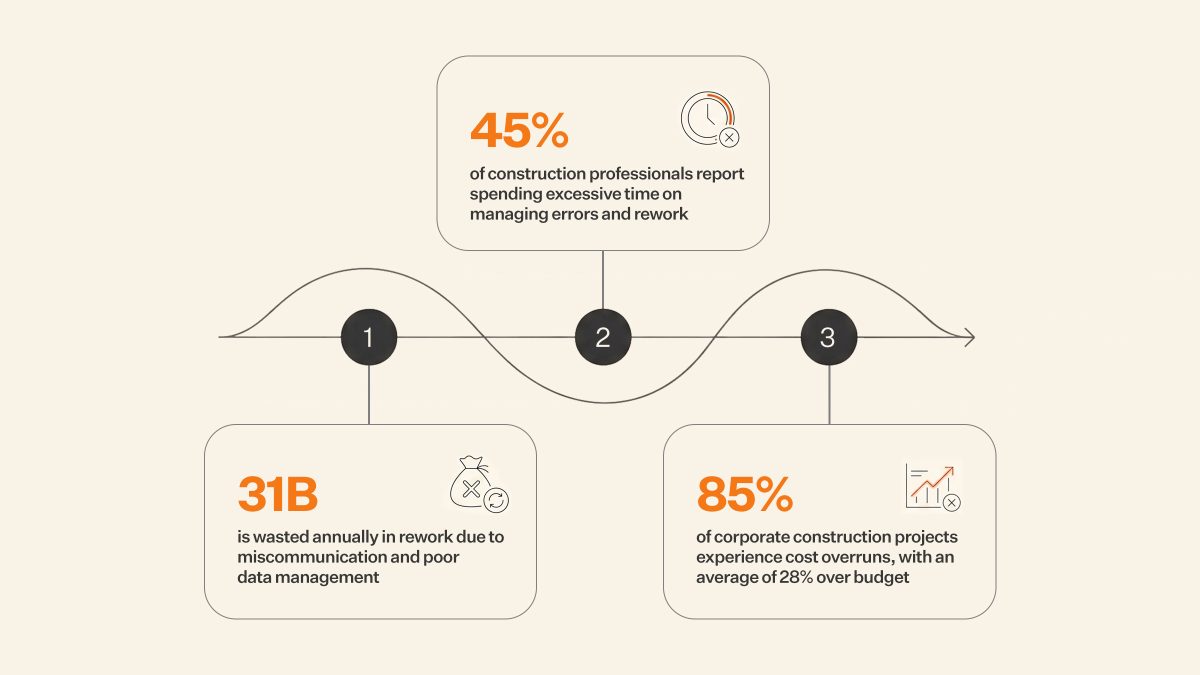 A large portion of project effort is absorbed by rework, driven by miscommunication and fragmented data, leading to significant cost overruns and time lost managing issues.
 Most workplace programmes begin with a clear strategic intent. Business objectives are defined, transformation goals are articulated and success criteria are established early. The complexity emerges later, as that intent is translated into delivery.
As information progresses from brief to design, from design to construction and from construction to operation, it is translated across disciplines, contracts and levels of resolution. Without a structured framework for continuity, each transition becomes a source of risk:
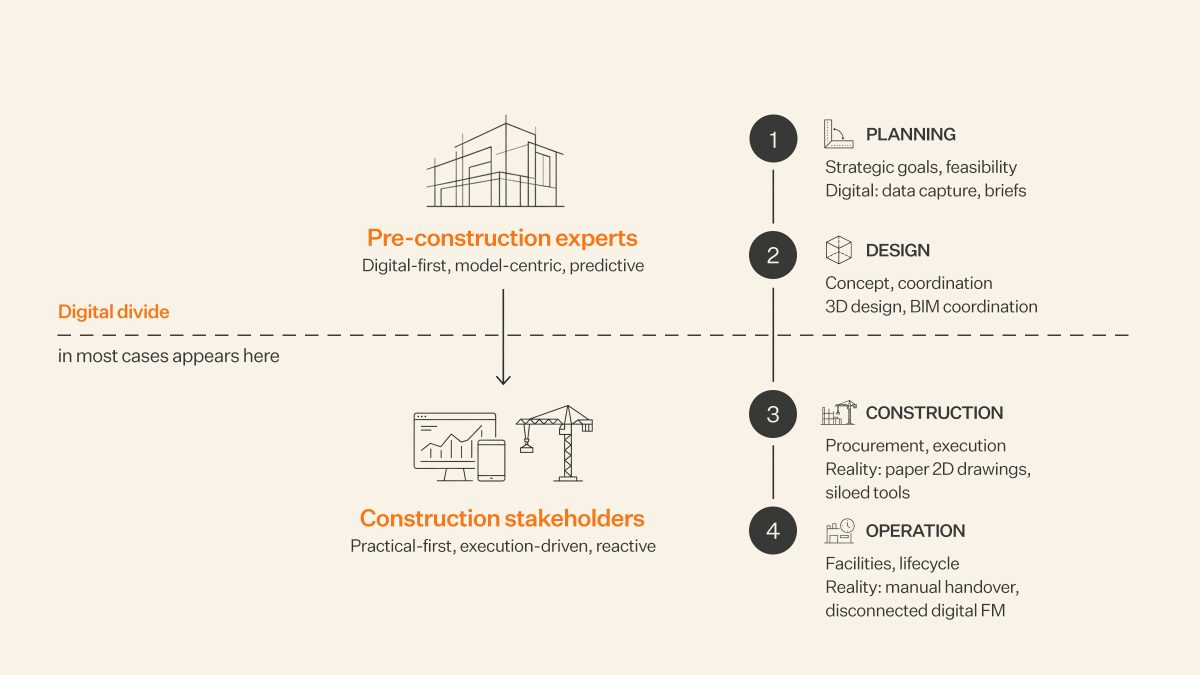 A disconnect persists between digitally driven planning and design phases and the more fragmented, execution-focused construction and operations stages, creating a gap where alignment and continuity are often lost.
 Misalignment has a cumulative impact. As uncertainty builds across phases, decision-making becomes local and reactive, with strategic focus shifting from transformation to issue management. Early validation of information is therefore critical. By aligning site conditions, base-build constraints and digital models before decisions are fixed, ambiguity is removed upstream.
When misalignment accumulates across earlier phases, its effects become most apparent on site. The construction environment is where design intent is tested against real conditions and where coordination directly influences programme certainty, cost control and quality outcomes.
Traditional coordination processes tend to rely on sequential clarification cycles: issues are identified, queries are issued, information is revised and updates are reissued. This approach introduces delay and encourages a reactive mode of delivery.
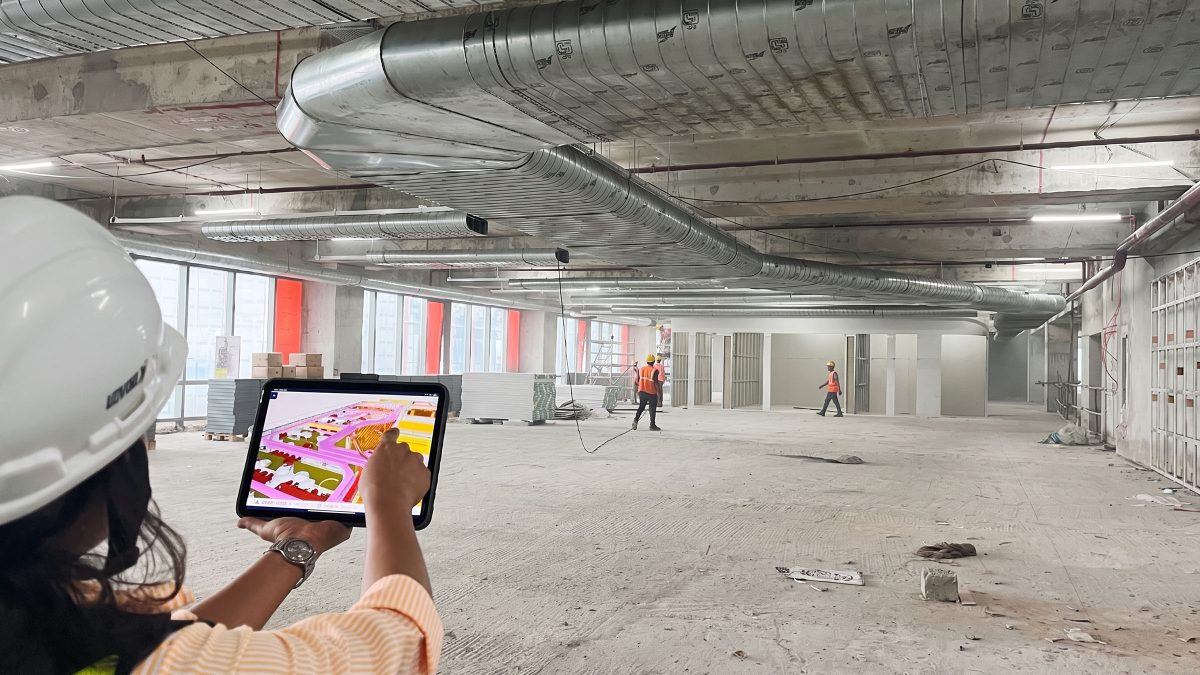
A more effective method treats coordination as a shared information challenge. When design intent, coordination data and live site conditions are accessible within a common environment, decisions can be made in context and at the point of need, rather than through layered escalation.
In this model, coordination shifts from correction to prevention. Rework is reduced, dependencies are more transparent and teams are better positioned to manage complexity collectively.
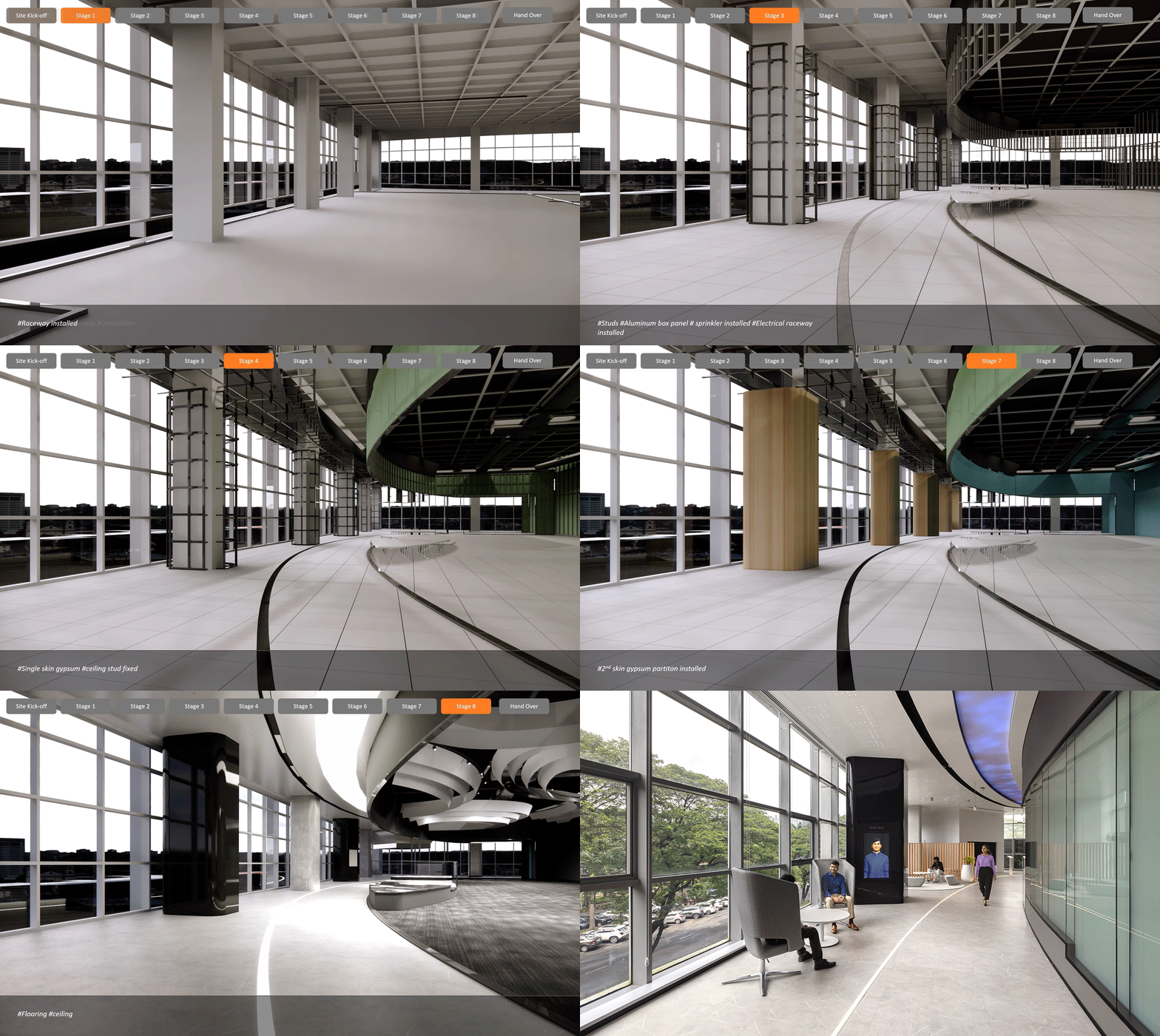 An early construction stage within a digitally enabled sequence, guiding the project from existing site conditions through to final completion.
 Handover is often treated as the conclusion of delivery. In practice, it marks the beginning of the longest phase of an asset’s life. Long-term value depends not on technology alone, but on how information is structured, connected and maintained over time.
Many operational challenges can be traced back to early design and construction decisions made without sufficient consideration of long-term use. When continuity of information is lost between delivery and operation, facilities teams inherit complexity without the context needed to manage it effectively.
Building for operations requires a different approach to project information. Rather than being treated solely as contractual deliverables, models and data are developed as enduring references that retain design intent, assumptions and decision history. When this continuity is preserved, operational activities such as maintenance, adaptation and future change become more informed and less reactive. Operational performance is therefore not a post-handover concern, but an outcome shaped from the earliest stages of coordination and delivery.
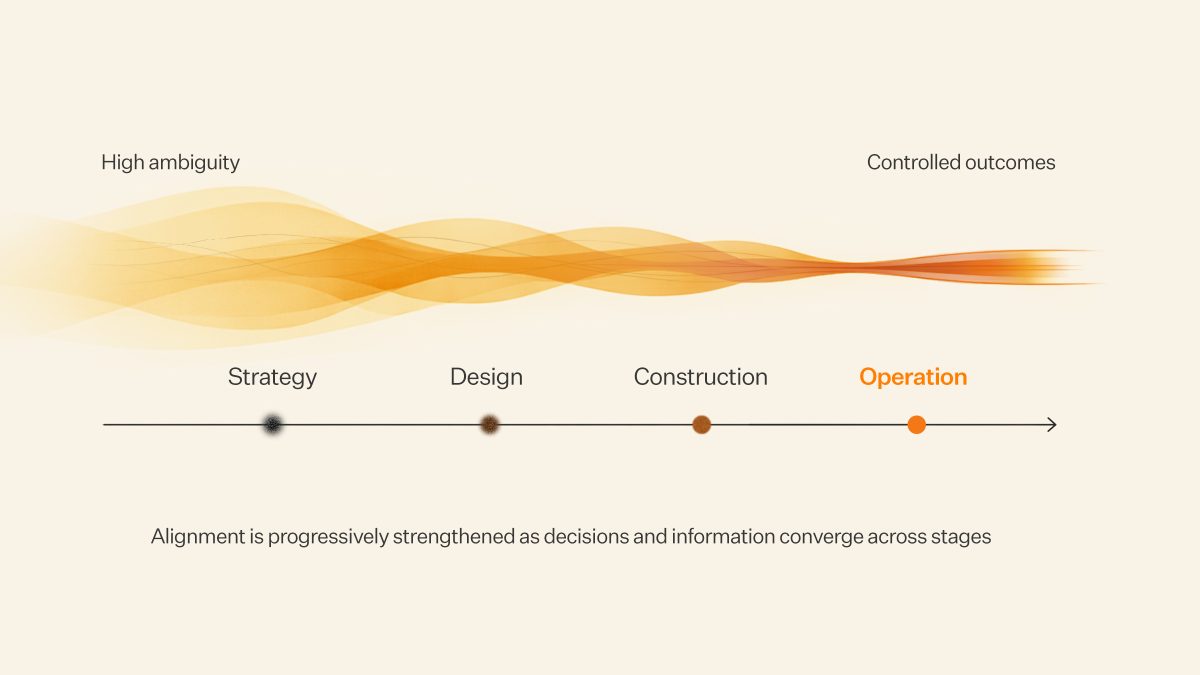
Keeping intent aligned as a project moves from strategy through delivery to operation is a persistent challenge. It needs to be maintained as decisions are tested, revised and implemented over time.
This is possible through an integrated approach that connects strategy, design, construction and operation by:
At M Moser, we combine specialist expertise, structured working practices and digitally enabled processes to maintain alignment throughout the project lifecycle. This work is led by dedicated subject-matter experts who operate across strategy, design, delivery and operations in synergy. In practice, this approach is operationalised through a coordinated set of delivery practices, evidenced on a recently completed large-scale banking campus in Chennai.
Our multidisciplinary team uses structured briefing and decision frameworks to translate strategic objectives into clear, testable requirements. On the Chennai campus, these frameworks created traceability between business objectives and design development, enabling multiple design revisions while maintaining programme continuity and alignment with strategic intent.
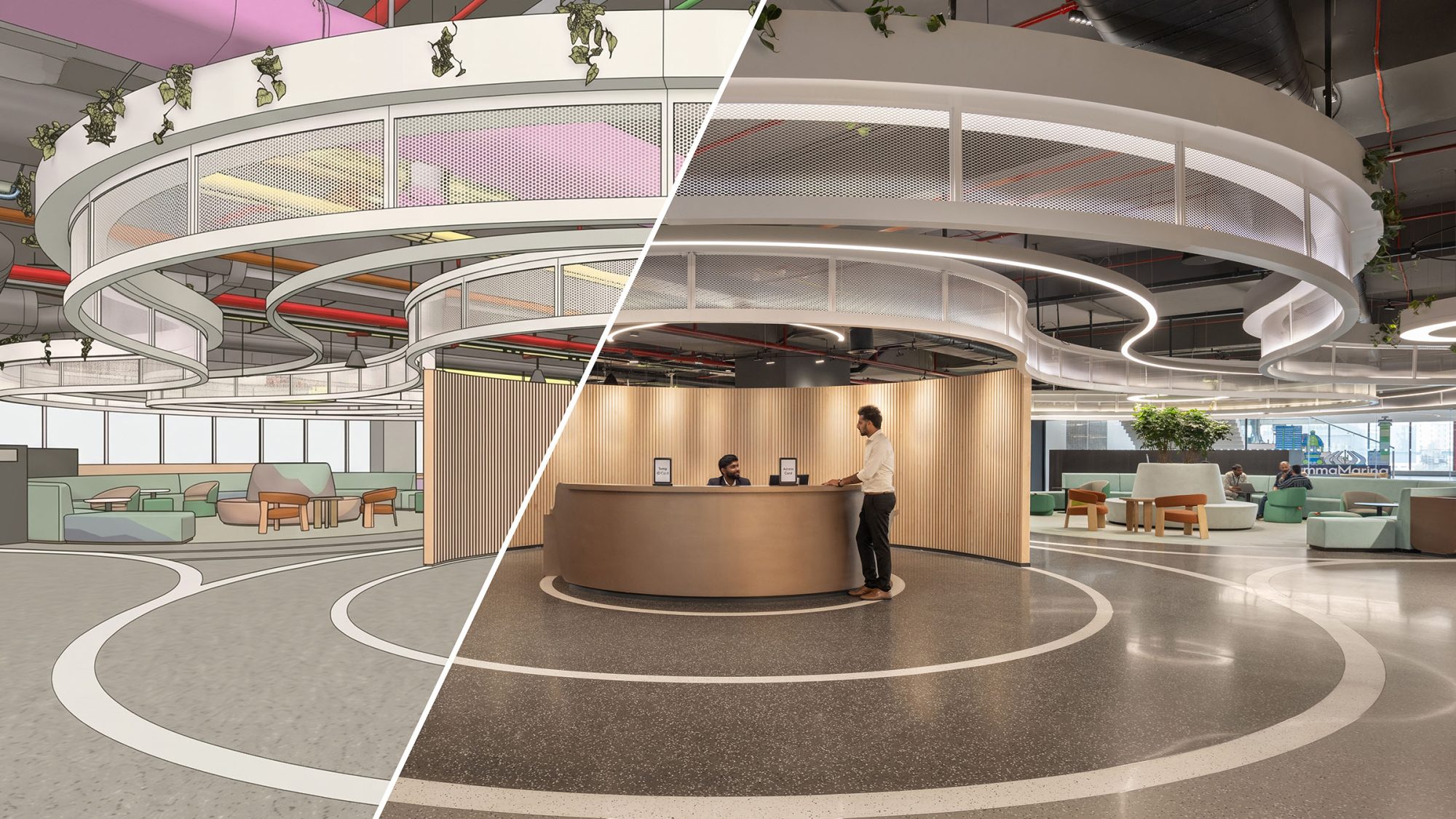
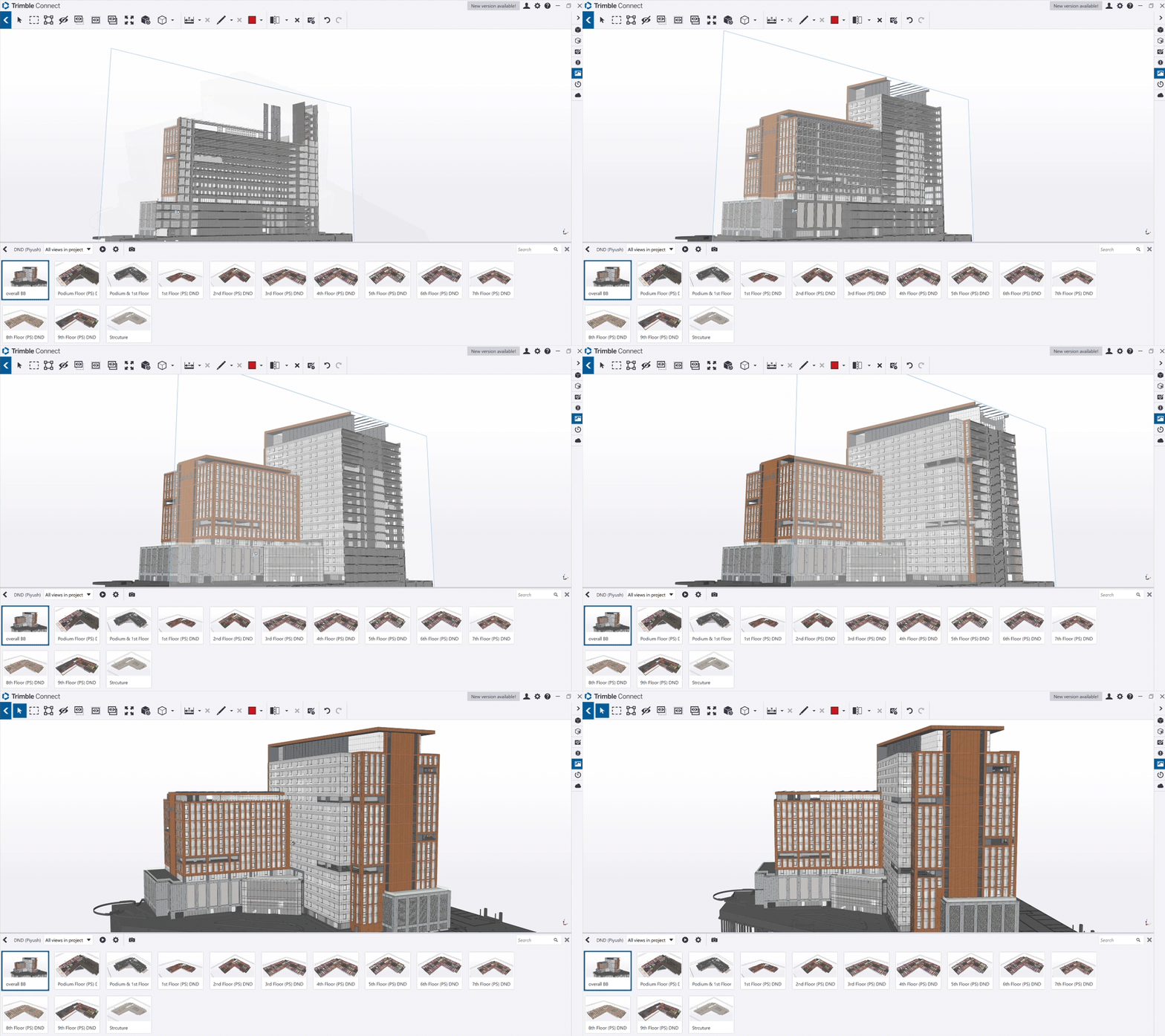 A coordinated digital building model enabling integrated review, analysis and decision-making across multiple design disciplines.
 Coordinated digital models act as a shared reference point for all project phases. Developed as information-rich environments rather than static deliverables, they support coordination on site and provide continuity. Over 30,500 modelling hours supported the identification and resolution of approximately 135,000 coordination clashes, systematically reduced to 145 residual clashes at the latest stage. Early validation of site conditions and base-build constraints significantly reduced downstream rework risk.
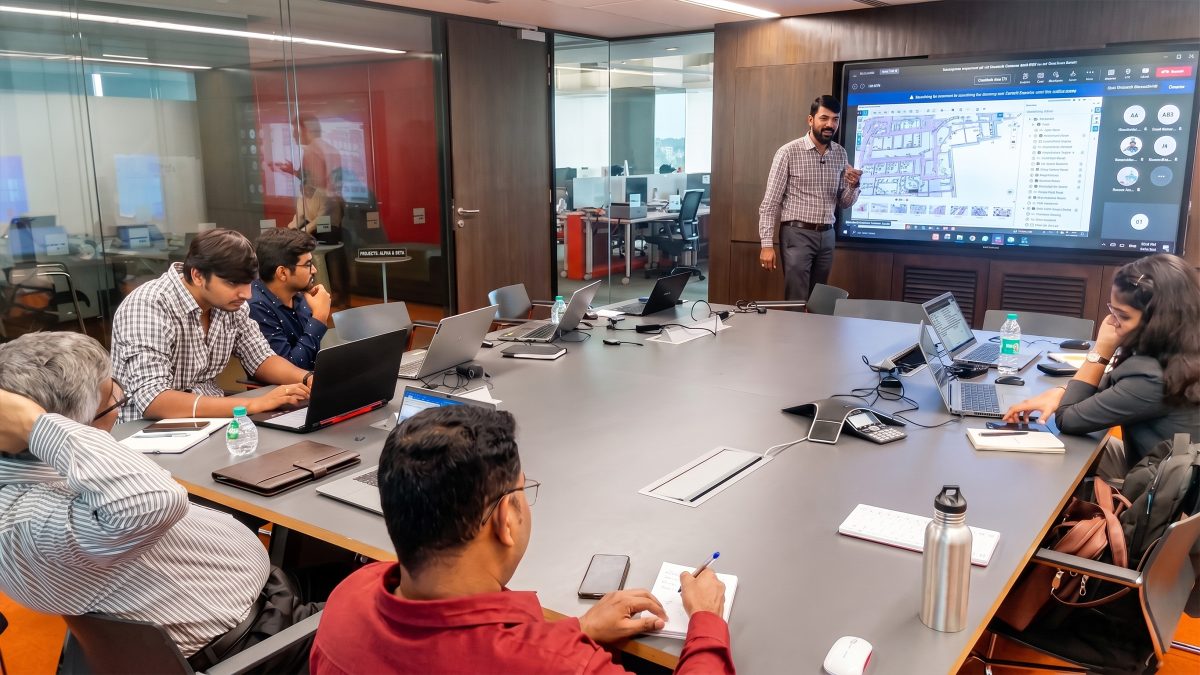
Shared coordination platforms enabled real-time access to information, improving decision-making and shifting delivery from reactive to proactive coordination. This was supported by 100+ workshops, 950+ hours of clash-resolution meetings and 3,600+ hours of follow-up coordination.
Defined governance and review moments provide structure for decision-making. Clear ownership, agreed escalation routes and regular cross-disciplinary reviews ensure issues are resolved in context rather than isolation. On this project, a disciplined governance model reduced rework and delays while improving efficiency relative to investment.
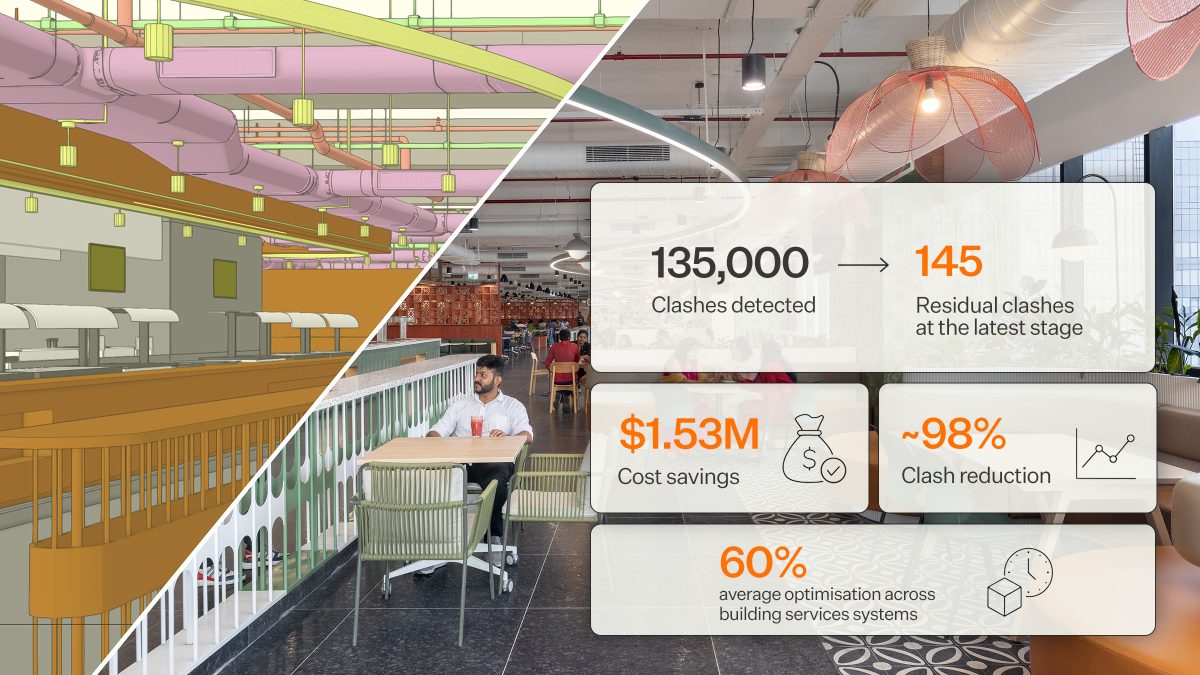 Proof of value from a Chennai banking campus project.
 Our team develops handover models and data structures with operational use in mind. Rather than closing out information at completion, project data is structured to support maintenance, adaptation and future change. On this campus, optimisation during coordination included:
– 85% optimisation of 6,000m of HVAC ductwork
– 60% optimisation of 39,000m of sprinkler lines
– 40% rerouting of 16,000m of cable trays, enhancing long-term maintainability and spatial efficiency
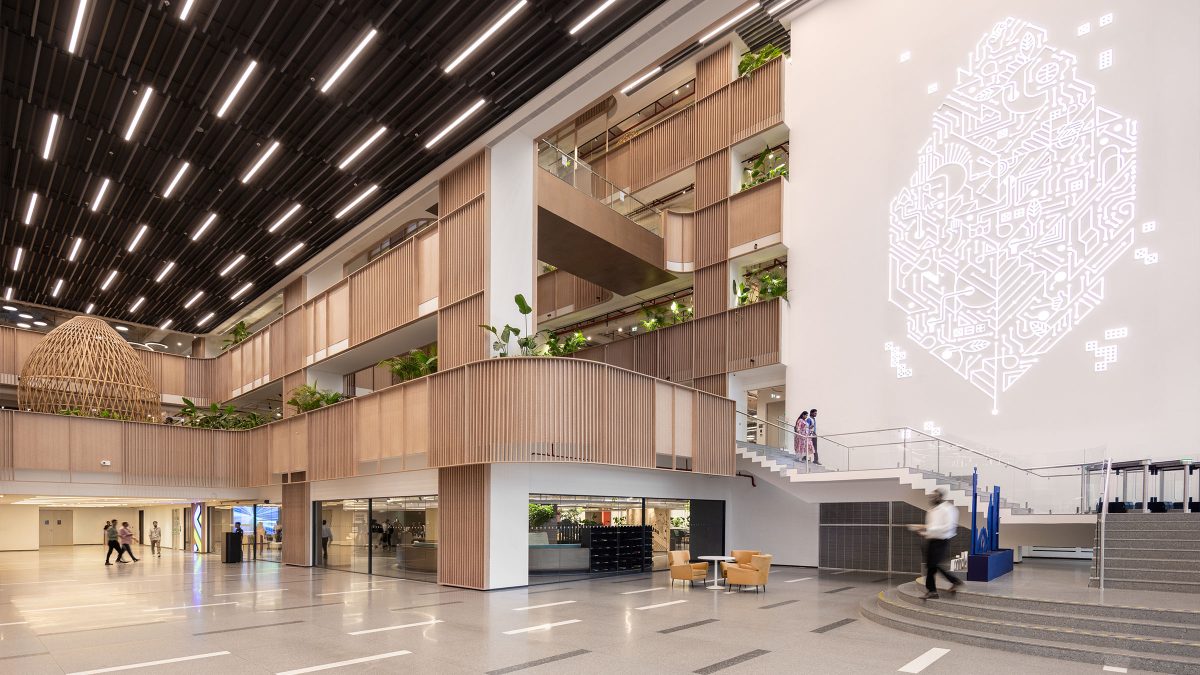
By making complexity visible and manageable, a structured workplace delivery methodology provides greater delivery certainty and long-term operational value for the workplace.
Director - AIBIM